Hey folks, let’s cut to the chase—if you’ve ever wandered through a vibrant market in Istanbul or a cozy boutique in Marrakech and spotted those glass lamps with tiny colored patterns that cast warm, shifting light all over the room, you’ve seen China Ottoman Turkish lamps. But what most people don’t know is that the story of these lamps isn’t just one of Ottoman craft—it’s a wild mix of Chinese porcelain traditions, Middle Eastern trade routes, and a few happy accidents that turned a niche decor piece into a global favorite. And if you’re here because you’re looking to add these beauties to your inventory, stick around—I’m a supplier who’s been at this for years, and I’ll break it down like I know it. China Ottoman Turkish Lamp
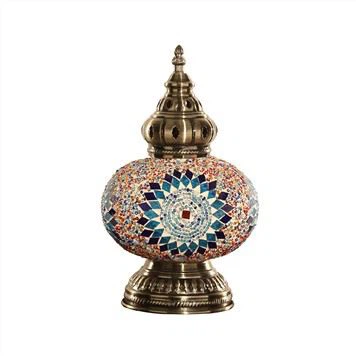
Let’s start way back, like 16th century back. The Ottoman Empire was at the peak of its power then, right? They controlled all the trade routes connecting Europe, Asia, and Africa, so they had access to basically every cool craft material from around the world. Back then, Chinese porcelain was the big flex—super durable, smooth, and those blue-and-white patterns were the shit. Ottoman artisans didn’t just import it to use as dinnerware; they started repurposing parts of it. Wait, no, actually, they started blending their own glass-making skills with Chinese porcelain aesthetics. Why? Because the Ottomans loved that intricate, hand-drawn design work, but they needed something that could be turned into a lamp, not a plate.
Back then, these lamps were for the top 1%—sultans, pashas, wealthy merchants. They’d hang them in palace courtyards, hammams, and even private homes as a status symbol. A normal person couldn’t afford one; they were hand-blown by master glassblowers in Istanbul’s Grand Bazaar, and each one took weeks to make. There’s a fun little detail I’ve heard from old artisans: they used crushed Chinese cobalt to get that deep blue color, which is why those early lamps have such a distinct, rich hue. No one really knows why they added it at first—some say it was a happy mistake, others say it was a way to show off they had access to rare Chinese materials. Either way, it stuck.
Fast forward to the 19th century, and stuff shifted. The Ottoman Empire started to decline, and a lot of master glassblowers moved away—some to Europe, some to parts of the Middle East. But the demand for these lamps didn’t die; it actually spread. European travelers who visited the Ottoman Empire brought them back home, and suddenly middle-class folks in France, England, and Germany were asking for them. But here’s the thing: the supply was tight. The original artisans were old, and no one was learning the craft. That’s when some enterprising people in China stepped in. Wait, no, not just China—artisans in Jingdezhen, the famous Chinese porcelain hub, started experimenting with Ottoman lamp designs. They’d make the glass, add the hand-painted patterns, and ship them to Istanbul to finish. It was a trade collaboration, plain and simple.
By the mid-20th century, mass production started to creep in, but the good ones— the ones with that authentic feel—were still made by hand. Then in the 1990s, globalization hit, and these lamps blew up in the US and other parts of Asia. People were obsessed with bohemian decor, and these lamps fit perfectly. That’s when I got into the business, honestly. I saw a gap: a lot of suppliers were cutting corners, using cheap glass and machine-made patterns, but I wanted to work with artisans who still knew how to make them the old way. That’s why I only source from small, family-run workshops that have been doing this for generations—no mass-produced garbage here.
Wait, let’s clear up a common myth: a lot of people call these “Turkish lamps,” but the history is split. The base design is Ottoman, the glass techniques draw from both Middle Eastern and Chinese porcelain, and today, the best ones are made by a mix of artisans in Turkey, China, and even Greece. The name “China Ottoman Turkish Lamps” comes from that cross-cultural origin—you’ve got Chinese craftsmanship, Ottoman design roots, and a trade route that tied them all together.
Here’s how they’re made, for anyone curious. First, the glassblower heats molten glass in a furnace until it’s super pliable. Then they blow it into a teardrop or pear shape—those are the classic shapes. Next comes the hand-painting step, which is where the Chinese influence shows up. Artisans use a fine brush and cobalt oxide (still, basically the same stuff from the 16th century) to paint tiny flowers, geometric patterns, or even scenes from Ottoman history. No stencils, no machines—each line is unique, so no two lamps are exactly the same. Then they add a metal cap (usually brass, for that warm look) and a glass diffuser inside to make the light spread evenly. The whole process takes about 10 days per lamp, and that’s why they’re not cheap—you’re paying for skill, not just a pretty decoration.
Now, why do people buy these? It’s not just the look. A lot of my clients—cafe owners, hotel managers, home decor boutique owners—say these lamps add a cozy, unique vibe that mass-produced stuff can’t. One of my regular clients runs a small boutique in Portland, Oregon, and she told me her customers ask about the history of the lamp every time they buy it. That’s the thing: these aren’t just light fixtures. They’re a piece of trade history, a mix of cultures that came together over hundreds of years.
I’ve seen a lot of fake versions out there lately—machine-made, cheap glass, printed patterns that look like hand-painted stuff. A lot of suppliers are pushing these as “authentic,” but they’re not. That’s why I make sure every lamp I sell comes with a little card that explains the history, so my customers know they’re getting the real deal. I work directly with the workshops, so I know every lamp is made by someone who’s been doing this for 20, 30, even 40 years. No middlemen, so the prices are fair, too.
If you’re a retailer, interior designer, or even just someone who’s been looking to stock these lamps in your space, let’s talk. I know a lot of people are tired of the same old decor options, and these lamps are a game-changer. Whether you need small table lamps for bedrooms, big hanging ones for restaurant lobbies, or bulk orders for a boutique, I can hook you up. I also offer customization—if you want a specific pattern or size, I can work with the artisans to make it happen.

Don’t hesitate to reach out if you want more info, want to see photos of the latest stock, or want to discuss pricing and minimum orders. This isn’t a big corporate thing; it’s a small, family-run operation, so I take the time to work with every client to make sure they get exactly what they’re looking for.
Humidifier References:
- The Ottoman Empire’s Glass and Porcelain Trade, 1500-1700 (Ottoman Studies Journal)
- Chinese Artisan Collaborations with Ottoman Craft Workshops (Journal of East-West Cultural Exchange)
- Evolution of Decorative Lighting in Global Markets (Modern Home Decor Research, 2021)
- Traditional Glassblowing Techniques in Istanbul’s Grand Bazaar (Crafts of Turkey Archive, 2019)
Yiwu Evershining Lighting Co., Limited
Find professional turkish table lamp manufacturers and suppliers in China here. We warmly welcome you to wholesale high quality turkish table lamp made in China here from our factory. For custom service, contact us now.
Address: Room 4B401, 4th Floor, Keyan Building, No.205, Tongbao Road, Jiangdong Street, Yiwu City, Zhejiang Province
E-mail: tina@glassmosaiclamp.com
WebSite: https://www.glassmosaiclamp.com/
