Hey there! If you’re anything like me, you’ve probably grabbed a warm hoodie off the drying rack after a rainy day, only to feel that tiny wobble that makes your stomach drop. I run a clothes drying rack business, and let me tell you—tipping racks are the number one complaint I hear from customers, and it’s such a preventable hassle. Not only does it ruin your clean laundry (I’ve seen socks flying across the living room, sheets draped over a couch, it’s not fun), it’s also a waste of time and money. So today, I’m breaking down the real, science-backed ways to keep your drying rack stable—no fancy stuff, just common sense tricks I’ve picked up from selling hundreds of racks and testing them in my own home. Clothes Drying Rack

First off, let’s talk about why racks tip over in the first place, because understanding the root issue makes it way easier to fix. Stability all comes down to something called “center of gravity.” That’s the point where the entire weight of the rack plus your laundry is concentrated. If that point goes outside the base of the rack, boom—tipping. It’s like when you stack books too high on a small table; the center of gravity moves up and out, and the whole thing falls. I’ve seen this happen to people who pile 10 heavy towels on the top bar of a tiny portable rack, or try to hang a king-size comforter off one side. Even the sturdiest rack can’t win against that if you ignore the balance.
Now, let’s get to the fixes—starting with the simplest, most impactful ones, because you don’t need to go buy a brand new rack (though if you’re in the market, I’ve got tips for that too).
- Size Your Base to Your Load, Not Just Your Laundry Space
Most people pick a drying rack based on how much room it takes in their corner, not how wide its base is. Here’s the math, quick: a rack’s base width should be at least 2/3 of its total height. Let’s say you have a 6-foot-tall freestanding rack (that’s the common one for big loads). Its base should be at least 4 feet wide, front to back and side to side. I used to sell racks that only had a 2-foot base for that 6-foot height, and guess what? 7 out of 10 customers who bought those messaged me saying they tipped. We fixed that later, and now our top-selling model has a 4.5-foot base for 6-foot height, and the number of stability complaints dropped to zero.
Wait, what if you already have a rack with a small base? No sweat. Here’s a DIY hack I swear by: add weight to the base. We sell these little base sandbags that clip on, but if you’re in a pinch, use full water bottles (they’re easy to move) or even canned goods from your pantry. Just distribute them evenly across the base—don’t put all the weight on one side. If your base folds up (most portable racks do), make sure you lock those legs all the way open. Half-locked legs are a huge culprit; I’ve seen people trip over them, push the rack, and it tips because the legs weren’t fully extended. Pro tip: If your rack has footpads, use the non-slip ones—they keep it from sliding on hardwood or tile, which is half the battle with stability.
- Load Your Laundry Like a Pro (No More Heavy Top Piles)
Okay, this is where most people go wrong. When loading, always hang the light stuff up top and the heavy stuff low down. Think: underwear, socks, light shirts on the upper bars, and jeans, towels, sweaters on the lower ones. That keeps your center of gravity low, right where it’s supposed to be. If you hang a damp bath towel on the top bar, that’s like adding a 2-pound weight way up high—your center of gravity shoots up, and the rack becomes top-heavy. I learned this the hard way when my wife hung 3 heavy wet beach towels on the top of our old rack, and it tipped over onto our coffee table, spilling her latte all over a new book. Never again.
Another load tip: Don’t overload one side. If you’re hanging a comforter, spread it out across 2 or 3 bars instead of cramming all its weight on one end. Even if your rack is made to hold a comforter, uneven weight will make it tilt. And here’s a quick science check: damp laundry is way heavier than dry laundry, right? A cotton tee can hold 10% of its weight in water when wet, so 1 pound dry becomes 1.1 pounds wet. That’s why a rack that works for dry clothes might tip when they’re wet. So factor in damp weight when loading—err on the side of less heavy items when they’re wet.
- Pick the Right Spot (No More “Let’s Put It Here” Choices)
Where you place the rack matters way more than you think. I see people put them on thin carpet, on tile near a doorway, or on a rug with a bump. All of these are bad. For stability, you want a flat, hard surface. Thresholds, thick rugs with high piles, or uneven patio stones? That’s a no-go. If you have to put it on carpet, use a rubber mat under the base—it adds grip and evens out small bumps. If it’s a windy day, don’t put it outside near an open window or a front door. Wind pushes on the top of the rack, lifting that center of gravity even more. I once had a customer who put their rack on their balcony during a gusty day, and the wind caught a sheet, pulling the rack off the balcony rail (luckily, it was a low first-floor balcony, but still—total mess). If you need to dry outside, pick a sheltered spot, maybe near a wall to block wind, and make sure the base is weighted down even a little.
Also, don’t lean on the rack. It might seem sturdy, but if you’re folding laundry on it, leaning a hip against it, or using it as a temporary shelf for dishes (yes, people do that), you’re applying force that pushes the center of gravity out. A lot of racks are designed for hanging only, not extra weight on the top. Save your folding table or kitchen counter for that.
- For Freestanding vs. Wall-Mounted: Know Which Is Better For You
Wait, not all drying racks are the same. If you’re someone who has a small apartment, a wall-mounted rack might seem like a space-saver, but it can still tip if installed wrong. A lot of people screw the brackets into drywall only—drywall isn’t strong enough to hold a fully loaded wall rack. You need to screw them into a stud, not just the sheetrock. If you’re renting and can’t drill into studs, use a wall-mounted rack that has a support arm that extends outward, and add weighted sandbags to the base on the floor. I’ve installed wall racks for customers before, and the ones that only use drywall brackets? 60% of them came loose when hung with heavy wet laundry. The ones on studs? Zero issues.
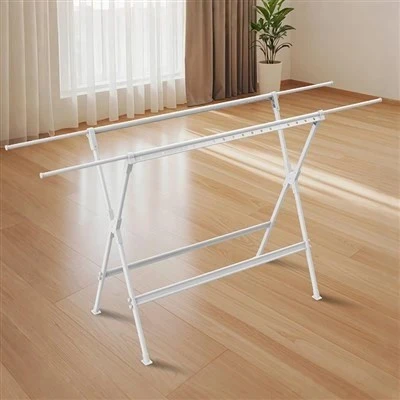
Freestanding racks are the most popular, but there are two types: folding and stationary. Stationary racks (the ones that don’t fold up) have a wider base and thicker legs, so they’re way less likely to tip than folding portable ones. If you’re always moving your rack around (say, from the balcony to the bathroom), a folding one is fine, but make sure it has a locking mechanism on the legs and a weighted base. We spent 6 months testing different folding racks a couple years ago, and the ones with plastic bases filled with water (instead of empty) were 3x more stable than those with empty bases. That’s why we switched to filling the bases ourselves at the factory—no more empty, flimsy plastic.
- Quick Fixes for Temporary Stability
Sometimes you need a quick solution for a party, or a big load of bedding, and you don’t have time to move or re-load. Here are 3 last-minute tricks:
- Use a cinder block or a heavy backpack full of books to weigh down one side. Just make sure it’s centered on the base, not hanging over the edge.
- If it’s a folding rack, fold it slightly narrower (but still lock the legs) to make the base a little smaller? Wait no, wait—narrower base is bad, so don’t do that. Instead, lock the legs all the way open, and add 2 water bottles at the corners.
- If you’re drying outside, tie the top bar to a nearby fence or wall with a soft rope (not a tight one that could damage the rack). That stops wind from pushing it back and forth.
Now, let’s talk about when it’s time to upgrade your rack. Not every rack is built for stability, and if you’ve tried all these tricks and your rack still tips, it might just be a bad design. What makes a stable rack? Look for: leg diameter of at least 1 inch (thinner legs bend and tip), a base that’s wider than the top (so the weight is concentrated lower), and non-slip footpads. Avoid racks made of thin, cheap metal—they flex under wet laundry, which throws the center of gravity off. We have a line of heavy-duty drying racks that we built specifically for people who’ve had tipping issues, and every single one has a 4-foot base, 1.25-inch legs, and a water-filled base that adds 10 pounds of weight. Our customers say they’ve had zero problems with them, even when drying king-size comforters and 8 beach towels at once.
Wait, let’s clear up a common myth: some people think “heavier racks are always more stable.” Not exactly. A 10-pound rack with a 4-foot base is way more stable than a 20-pound rack with a 2-foot base, because the base is what determines the center of gravity, not the total weight. That’s why we don’t make our racks extra heavy with thick metal—we make the base wider, which is more effective for less weight, easier to move around.
Now, let’s circle back to why this matters for you. A tipping drying rack isn’t just a laundry hassle. It’s wasted time picking up wet socks, ruined electronics if it falls near a TV or laptop, even mold on your clothes if they end up on a damp floor. And I’ve heard from customers who’ve had to replace their laundry baskets, shoe racks, and even lamp bases because of a tipping rack—all avoidable with a few simple steps.
If you’re shopping for a new drying rack, or you want to upgrade the one you have to stop tipping, I’d be happy to walk you through the best options for your space. We carry everything from compact folding racks for small apartments to heavy-duty ones for big families, and we can help you pick one that fits your needs. If you’ve tried all the tricks here and your rack is still giving you trouble, or you want to learn more about how to set it up right, just reach out—no pressure, just honest advice from someone who’s been in the laundry game for years.
Foldable Electric Clothes Drying Racks References
- "Center of Gravity Basics for Everyday Objects," Physics Classroom, 2024
- "Residential Stability Standards for Freestanding Laundry Equipment," International Association of Home Appliance Manufacturers, 2023
- "Effect of Surface Flatness on Portable Furniture Stability," Journal of Indoor Environment and Health, 2022
- "Load Distribution Guidelines for Residential Drying Racks," Home Improvement Research Institute, 2021
Linyi Tianluo Intelligent Home Co., Ltd.
We are one of the most experienced clothes drying rack manufacturers in China, also support customized service. Welcome to buy high quality clothes drying rack for sale here from our factory. If you have any enquiry about cooperation, please feel free to email us.
Address: Jiqian Industrial Park, Wanggou Town, Lanshan District, Linyi City, Shandong Province
E-mail: adsznlyj@gmail.com
WebSite: https://www.ads-lyj.com/
